
Average Net Worth In The Us
Let’s be real: checking your bank account after a quick scroll through social media can feel like a personal attack. You see your college roommate’s yacht-adjacent vacation photos, and suddenly your savings account feels less like a safety net and more like a napkin. But before you spiral, let’s talk about the actual numbers behind the average net worth in the US—and why they probably don't mean what you think they mean.
Think of net worth as your financial fingerprint. It’s the total value of everything you own (your home, car, investments, that vintage vinyl collection) minus everything you owe (credit cards, student loans, that IOU to your buddy). It’s not about your salary; it’s about the accumulated wealth you’ve built over time.
The Big, Shiny Number (And Why It’s a Lie)
Here’s the headline-grabbing stat: the Federal Reserve’s latest data shows the average American net worth is hovering around $1.06 million. Yes, you read that right. But before you throw your iced coffee in frustration, you need to meet the median net worth, which tells a very different story.
Must Read
The median net worth—the exact middle point where half of Americans have more and half have less—is roughly $192,700. That’s a massive gap, and it’s all because billionaires like Elon Musk and Warren Buffett skew the “average” into the stratosphere. It’s the same reason why a bar with Bill Gates in it technically has an average patron worth $99.9 billion, but you’re still ordering a $6 beer.
So, which number is actually you? The median is your reality check. It shows that the "average" American isn't lounging on a pile of cash; they're likely sitting on home equity and a 401(k) that’s seen better days.
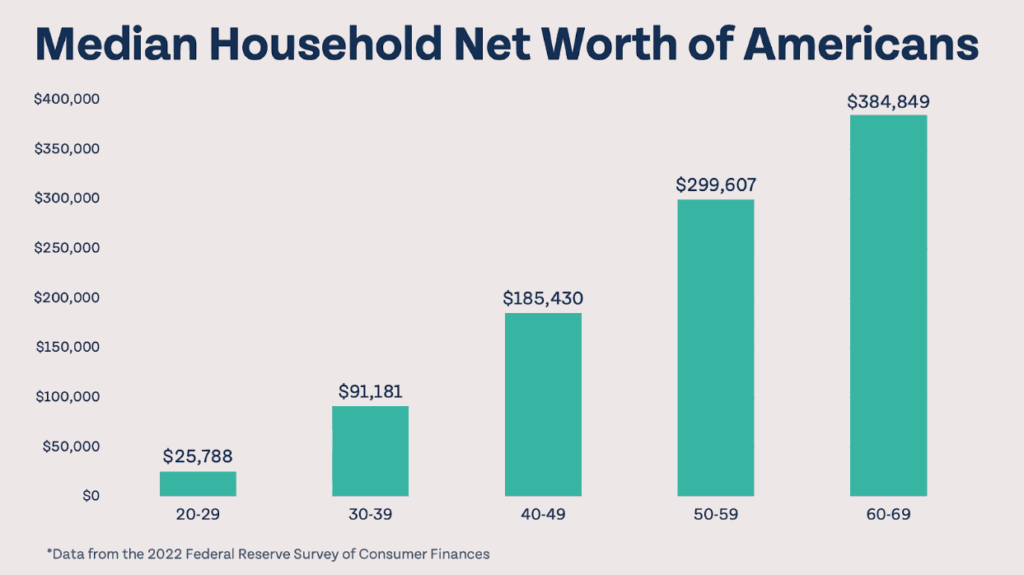
The Age Factor: Your Net Worth Timeline
If you’re feeling behind, remember that net worth is a marathon, not a sprint. The Fed’s data breaks it down by age, and the progression is both comforting and a little daunting. In your 30s, the average net worth is around $76,000, but the median is closer to $35,000—because most of you are drowning in mortgage payments and daycare costs.
Fast forward to your 40s and 50s, and the numbers start to compound. The average net worth for those aged 45-54 jumps to over $900,000, but the median settles around $168,000. This is the "wealth-building" decade, where your investments finally start doing the heavy lifting while you’re busy dealing with teenage angst.
The real magic happens in your 60s. That’s when the average net worth peaks above $1.2 million, and the median hits $410,000. This is the payoff for decades of 401(k) contributions and the glorious moment when your house finally feels like an asset instead of a money pit.
Why Your Zip Code Matters More Than Your Paycheck
Here’s a fun little cultural reference for you: In Sex and the City, Carrie Bradshaw famously had a walk-in closet but couldn’t afford her apartment. That’s the ultimate net worth paradox. Your geographic location is the single biggest predictor of your net worth. Living in San Francisco or New York inflates your real estate value, but it also inflates your rent and your avocado toast budget.
Meanwhile, a homeowner in Ohio with a modest income might have a higher net worth than a tech bro in Austin renting a studio. Why? Because home equity is the primary driver of wealth for most middle-class families. The 2020s housing boom turned a lot of suburban dads into accidental millionaires—or at least slightly more comfortable 401(k) holders.

And don’t forget the stock market. The rise of "meme stocks" and fractional shares has democratized investing, but it’s also created a new generation of paper millionaires who panic-sold during the last dip. The key is to buy and hold, not to check your portfolio every five minutes like it’s a sports score.
How to Bridge the Gap: Practical, Low-Key Tips
You don’t need a finance degree to boost your net worth. Start by tackling high-interest debt like it’s the final boss in a video game. Credit card interest is the silent killer of wealth—paying off a $5,000 balance at 22% APR is essentially giving up a free Caribbean vacation every year.
Next, automate your savings. Set up a direct deposit into a high-yield savings account or an index fund before you even see the money. It’s the same psychology as a gym membership: if it’s automatic, you’re less likely to skip it. Even $50 a week adds up to $2,600 a year, and with compound interest, that’s a solid start.
Also, stop comparing your net worth to your friends who inherited a house or won the startup lottery. Instead, do a "net worth date night" with your partner or yourself—a quarterly review of what you own and owe. It’s not sexy, but it’s more productive than doom-scrolling Zillow for houses you can’t afford.
Fun fact: Did you know that the median net worth for renters is less than $10,000, while for homeowners it’s over $400,000? That’s not a coincidence. Even a small starter condo can be a wealth-building tool, but it’s not the only path—investing in low-cost ETFs is the modern-day equivalent of buying a duplex in the 80s.
The Takeaway: It’s About Your Vibe, Not Just Your Balance
At the end of the day, net worth is a tool, not a report card. It’s useful for measuring financial health, but it doesn’t measure your happiness, your relationships, or your ability to laugh at a meme at 2 AM. If you have a solid emergency fund, no crippling debt, and a habit of saving, you’re doing better than the "average" suggests.
So, next time you see a headline about the average net worth, don’t sweat it. Instead, grab a coffee, check your 401(k) balance with one eye closed, and remember that the journey to wealth is less about gigantic leaps and more about slow, steady steps. You’re not behind; you’re just on your own timeline—and that’s perfectly on-brand.